Core loop · storm, light, ghosts
How to survive 100 Miles Down the River
Every survival rule this game publishes fits in one sentence: something in the storm is hunting you, so stay in the light. Everything after that sentence is what the community has to figure out. This guide organizes that figure-outing — what the storm does, what the light buys you, what happens when you go down, and which officially tracked behaviors (cooking, journals, clean runs) quietly carry long runs.
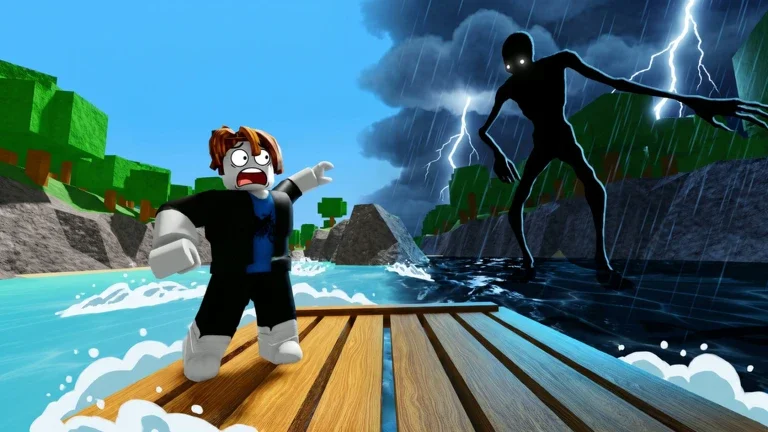
The hunter in the storm, as officially stated
Start with what the developer actually promises: “Something in the storm is hunting you.” That phrasing is deliberate. The threat is singular, it is attached to the storm rather than to random encounters, and it hunts — a word that implies pursuit rather than passive hazards. Gameplay footage consistently shows the same shape of run: calm stretches of drifting, then storm cycles where a pursuing presence forces the raft to react. The game rates itself Mild horror and Mild violence, and that is exactly the register of the threat — a chase that ends your run if you handle it wrong, not a horror set-piece.
What the game does notpublish: the hunter's speed, its exact trigger conditions, or any damage formula. You will find sites that quote such numbers with confidence. None of them can source it, and neither will we. What we can anchor is behavior: the badge Untouched requires reaching Mile 25 “without ever getting knocked down” — official proof that the normal consequence of a bad storm encounter is a knockdown, not instant elimination. You get knocked down, you become a ghost, and the run continues if your crew brings you back.
Stay in the light — the one rule worth memorizing
The official description ends with the countermeasure: “Stay in the light.” One sentence, written by the developer, describing the defense against the hunter. In footage, the light lives on the raft — lantern duty is a real job, and storm cycles punish paddlers who wander from it. Read the rule practically and three disciplines follow:
Assign the light before the storm, not during it
The storm does not schedule itself around your crew's discussion. On any crew bigger than three, one player should own the light at all times, and the others should know who that is. When the hunter closes in, nobody should be discovering who has the lantern.
Treat the light as a location, not an item
The phrasing is “stay in the light,” not “hold the light.” The safe zone is where the light is — which means paddling the raft toward your people matters as much as paddling it toward the next mile. A crew that spreads out has effectively multiplied the hunter's targets.
Keep paddling through the storm
Mileage does not accrue while you cower. The milestone badge curve — Halfway There at a fraction of a percent of visitors — says most crews lose too much time to the storm to ever reach deep miles. Storms are survived while moving, not while stopped.
Death is a state: ghosts, Sparks and revives
This is the game's friendliest design decision and the one beginners understand last. Two official badges spell out the entire system. Back to Life: “Come back to life as a ghost by grabbing a Spark.” Lifesaver: “Revive 5 crewmates.” Between those two sentences, the whole loop is documented — getting knocked down converts you to a ghost; Sparks exist in the world; grabbing one while dead brings you back; and your crew can revive you directly. With 13,435 players holding Back to Life and only 1,109 holding Lifesaver, the stats also tell you something: coming back as a ghost is routine, personally reviving five crewmates is a badge-worthy career.
| Badge | Official description | Players awarded | What it proves |
|---|---|---|---|
| Back to Life | Come back to life as a ghost by grabbing a Spark. | 13,435 | Self-revives are normal |
| Lifesaver | Revive 5 crewmates. | 1,109 | Crew revives are rarer |
| Untouched | Reach Mile 25 in one run without ever getting knocked down. | 315,716 | Knockdowns are the normal failure |
The tactical consequence: when someone goes down, the run does not pause, but the priorities invert. The fallen player's job is to reach a Spark. Everyone else's job is to keep the raft — and the light — close enough that the Spark is reachable before the storm cycles again. Crews that treat a knockdown as a hiccup run deep; crews that treat it as a wipe do not.
The quiet survivors: cooking and journals
Two badge tracks reward things that have nothing to do with the storm, and both quietly support long runs. Camp Cook — “Cook 50 meals” (68,814 players) — makes food a routine, which means crews that cook steadily enter every storm cycle in better shape than crews that scramble. Full Journal — “Find every note and journal page on the river” — has only 52awards worldwide, making it the rarest collection goal in the game. Journal pages are found along the river, so crews that sweep for them naturally slow down, search side spots, and learn the river's geography — knowledge that pays off on every later run.
Neither system is documented in detail anywhere official. What the badges prove is that the loops exist and are completable. Treat them as the difference between surviving one storm and surviving twenty.
A storm-cycle routine you can drill
Since no stat sheet exists, the most honest survival advice is procedural. A repeatable storm routine, consistent with everything the game officially states:
- Before the cycle: confirm the light keeper, top off on cooked food, and agree the raft never splits up.
- Early storm: keep paddling at cruising pace — distance banked before the hunter closes is distance you don't have to fight for later.
- Active pursuit: everyone converges on the light; the paddle crew keeps the raft ahead of the hunter rather than fighting it head-on.
- After a knockdown: the ghost heads for the nearest Spark while the crew keeps the light mobile and reachable.
- After the cycle: cook, sweep for journal pages, and resume pace immediately — long runs are won in the calm, not the storm.
That routine is deliberately free of invented numbers. When the developers publish real mechanics — or when a major update changes them — this page gets rewritten the same day; the update tracker records when.
Reading survival claims you see elsewhere
As the game grows, you'll meet confidently written guides quoting hunter speeds, spawn timers and damage values. Apply one test: where did the number come from? The game exposes no combat log, no API endpoint for storm behavior, and no developer changelog. Claims that precise cannot be sourced — they are guesses dressed as measurements. The badge statistics on this site are different: they come from Roblox' own API with a capture date, and you can verify every one of them in under a minute.
The same test protects you from the opposite failure: “the storm is unpredictable, nothing works” fatalism. The badge data says otherwise — Untouched (Mile 25, never knocked down) has been earned by hundreds of thousands of players, which is direct evidence that the storm is learnable. Between invented precision and invented despair lies the actual game: a learnable routine, published statistics, and a river that pays the crews who drill both.
Bring the crew
Next: raft building & co-op