Co-op · 20-player servers · revives
Raft building & co-op play
The official pitch puts three players' worth of emphasis on one activity: “Build a raft with friends and ride the river.” The raft is your base, your vehicle, your light source and your revive station — and the game's co-op badges turn teamwork into tracked achievements. This guide covers what the game officially says about building and crewing a raft, and how to run a 20-player server without dissolving into chaos.
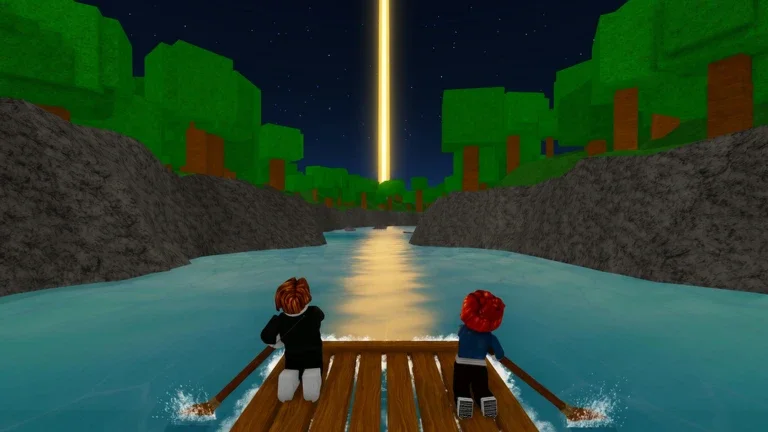
What a raft is, officially
The game defines the raft by its roles, not by parts. It is the vehicle (“ride the river”), it is where the light lives (“stay in the light” — the one documented countermeasure to the hunter), and it is the rally point of the revive loop (Sparks and crew revives happen around the raft, not across the map). No official source enumerates build parts, material costs or durability values — so unlike tier lists you may have seen elsewhere, this guide does not rank upgrades it cannot verify. What matters is which jobs the raft must perform, because the badge ladder has already proven they exist.
Build order therefore follows roles. Something that floats and carries the crew. Something that keeps a light mounted where everyone can reach it. Space for the cooking loop (Camp Cook exists, so meals are a raft activity). And enough free deck that a ghost can move toward a Spark without navigating a maze of clutter — the Back to Life badge is earned by 13,435 players, most of them on rafts where reaching the Spark was possible under pressure.
The co-op badges are a teamwork syllabus
The game tracks three explicitly social badges, and together they read like a course in crew management:
| Badge | Official description | Players awarded | Teamwork lesson |
|---|---|---|---|
| Bring a Friend | Invite a friend who joins you. | 20,177 | Runs go better with people you know |
| Back to Life | Come back to life as a ghost by grabbing a Spark. | 13,435 | Ghost duty is a job, not a timeout |
| Lifesaver | Revive 5 crewmates. | 1,109 | Reviving is rare enough to be a badge |
Bring a Friend's 20,177 awards versus Lifesaver's 1,109tells a clear story: most crews are friends who queued together, but reviving five crewmates in one lifetime is uncommon enough to be decorated. Crews that run storm cycles tightly — converging on the light, retrieving Sparks fast — revive far more often than loose crews, purely because proximity creates opportunities.
Crew roles for a full server
With 20players per server, the difference between a crew and a crowd is role clarity. These five roles come from the game's own systems — every one maps to something an official badge tracks:
- Light keeper — owns the lantern station. The single most important job; “stay in the light” is the game's only documented defense.
- Paddlers — keep the raft moving at cruising pace. Mileage accrues to crews that move through storms, not ones that wait them out.
- Cook — runs the Camp Cook loop (“Cook 50 meals” is the badge; steady meals are the point). Cooked food before storm cycles, not after.
- Scout — sweeps for journal pages during calm stretches. Full Journal requires “every note and journal page on the river,” and only 52 players have managed it — because finding them all takes deliberate, repeated sweeps.
- Ghost marshal — watches for knocked-down crewmates and coordinates Spark retrievals. This is the role that turns deaths into hiccups and feeds the Lifesaver badge.
On smaller crews, roles fold: light keeper and cook combine, scout and paddler combine. What must never fold is light ownership — the moment everyone assumes someone else has the lantern, the storm finds out first.
A note on rotation: long runs burn people out, and the roles are not equally tiring. Paddling is steady work, light keeping is high-stakes vigilance, and ghost marshaling is spike-and-trough stress. Crews that rotate the light every few storm cycles keep their keeper sharp — and rotating through ghost duty teaches everyone the Spark retrieval that the Back to Life badge measures.
Public servers vs. friends-only
Public servers give you strangers, and strangers on the river behave like strangers anywhere: some paddle, some spectate, some board your raft uninvited. The game's own numbers show most players run with friends — Bring a Friend is one of the more common co-op badges — and the deep-mile badges are dominated by coordinated crews. If you're playing public, treat the first five miles as an audition: who paddles, who panics, who shares. Then raft up with the keepers.
One honest caveat: the game does not document any friend-only mode or private server feature on its official page, so queueing together through the Roblox group or the game page is the reliable way to land in the same server. Anything beyond that — VIP servers, invite codes — we won't claim, because we can't verify it.
Raft etiquette that keeps crews together
Public-server rafts rise and fall on etiquette more than on building skill. Three norms, all consistent with how the game's systems work, keep a mixed raft functional. Announce before you board — a raft that gains three silent passengers loses light discipline instantly, and the storm punishes exactly that. Ask before rebuilding — tearing down a section someone else placed, mid-storm, is how rafts lose their light mounts at the worst moment. And share the produce — the cooking loop only feeds crews that actually pool what they gather, which is why Camp Cook is a badge about routine rather than about one good meal. None of these are written in the game; all of them follow directly from how its systems interact.
On friends-only rafts these norms compress into habits, but the fifth rule always applies: the raft is the revive station. Ghosts path back to it, Sparks get carried to it, and Lifesaver revives happen on its deck. Keep the deck clear enough that a dead player can move — cluttered rafts save seconds on paper and lose players in practice.
The exception that proves the teamwork: Lone Paddler
For every co-op badge there's an anti-badge. Lone Paddler — “Reach Mile 100 all alone. The rarest badge on the river” — has 2,056awards worldwide. It exists because the game knows its own design: a solo player has no one to hold the light reliably, no one to revive them, no ghost marshal. The raft still has to be built, cooked on, lit and paddled — by one person. That's why solo runs are the rarest achievement the game tracks, and why crews shouldn't feel bad about needing each other. The developer built the whole game around the opposite of going alone.
Endgame
Next: the road to Mile 100